Privacy in crypto used to be viewed as an edge-case feature for cryptographic purists. Today, public ledgers have effectively created transparent surveillance systems where wallet history, trade positions, and balance sheets are exposed to anyone with a block explorer.
As institutional money moves deeper into digital assets, full transaction transparency is turning into a competitive liability. Companies cannot publish their payroll on a public blockchain, nor can hedge funds reveal their liquidations to market front-runners.
This shifts the narrative back to Zcash (ZEC). Launched in 2016, Zcash pioneered practical zero-knowledge cryptography. After experiencing significant market volatility ranging from sub-$30 lows in early 2024 to strong rallies toward $500–$700 in late 2025—Zcash enters 2026 as a major test case for compliant, institutional-grade privacy.
This guide breaks down realistic Zcash price forecasts through 2030, the mechanics driving ZEC adoption, and how to evaluate its risks cleanly.
Key Takeaways
Optional Privacy Is the Catalyst: Zcash uses zk-SNARKs, allowing users to choose between public (t-addresses) and fully private (z-addresses) transactions. Selective viewing keys make it auditable for tax and compliance purposes.
2026 Market Setup: Following a massive late-2025 rally where ZEC broke past multi-year resistance, the asset is trading in an active consolidation phase near $450–$520.
Institutional Support: Grayscale’s Zcash Trust and integrations with cross-chain protocols (such as NEAR) provide steady structural demand compared to privacy coins without audit capabilities.
Key Risks: Regulatory pressure against private transactions and CEX delisting threats remain the primary downside bottlenecks.
What Is Zcash (ZEC) and How Does It Work?
Zcash was created as a fork of Bitcoin’s code base to solve a specific problem: Bitcoin records every transaction sender, recipient, and amount publicly on-chain. Zcash adds optional confidentiality without sacrificing blockchain security.
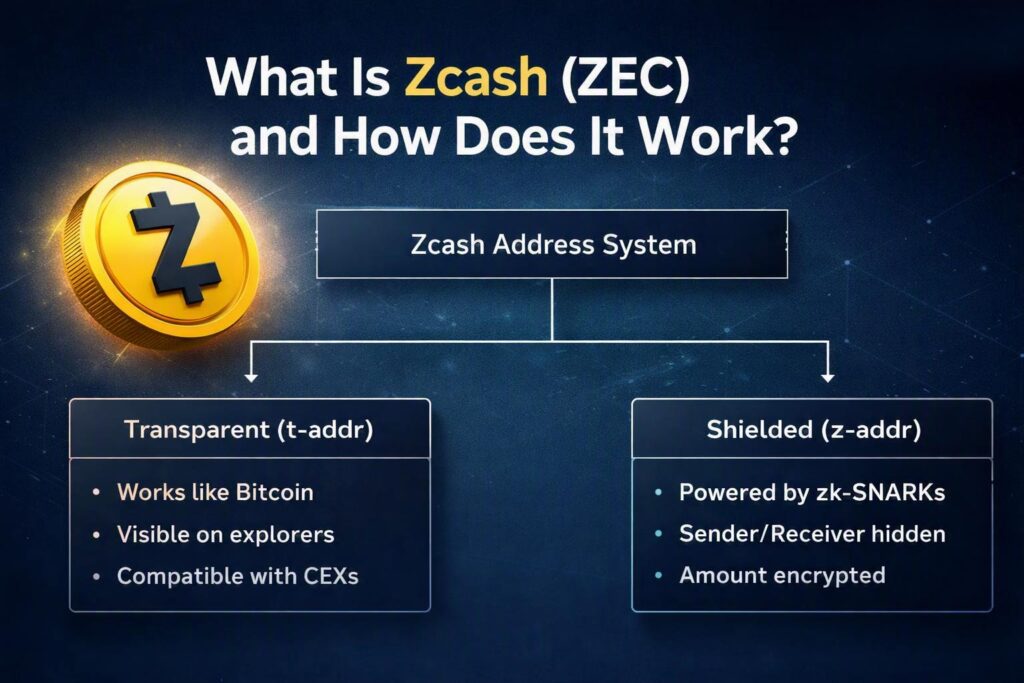
Dual Address System
Zcash operates two distinct wallet formats:
- Transparent Addresses (t-addresses): Behave like standard Bitcoin addresses. Balance and transfer amounts are visible on public explorers.
- Shielded Addresses (z-addresses): Use zero-knowledge proofs (zk-SNARKs) to encrypt the sender, recipient, and transaction values.
The Shielded Pools: Sprout to Orchard
Zcash has upgraded its cryptography over time to make privacy faster and lighter:
- Sapling & Halo 2: Early setups required heavy computing power and a trust-based setup ceremony. The Orchard shielded pool (introduced with the Halo 2 proving system) eliminated trusted setups entirely.
- Unified Addresses: Modern wallets use Unified Addresses (UAs) that automatically select the best pool (Orchard) while keeping backward compatibility. Over 25% of all circulating ZEC now sits inside shielded pools.
Real-Time Zcash (ZEC) Market Overview
Data updated mid-2026. Crypto asset prices fluctuate rapidly; always check live market feeds before trading.
| Metric | Current Value / Range |
| Circulating Supply | ~16.3 Million ZEC |
| Max Supply Cap | 21.0 Million ZEC (Matches Bitcoin) |
| 52-Week Price Range | $38.50 – $741.38 |
| Current Resistance Levels | $550.00 / $620.00 / $750.00 |
| Key Support Levels | $380.00 / $280.00 / $200.00 |
| Consensus Mechanism | Proof-of-Work (Equihash) |
Zcash Price Prediction 2026–2030
Price projections combine technical analysis, historical cycle trends, and fundamental adoption metrics. Below are potential scenarios across moderate, bullish, and conservative conditions.
Zcash Price Forecast Table (2026–2030)
| Year | Bearish Target (USD) | Average Target (USD) | Bullish Target (USD) |
| 2026 | $280.00 | $480.00 | $720.00 |
| 2027 | $320.00 | $550.00 | $890.00 |
| 2028 | $410.00 | $680.00 | $1,150.00 |
| 2029 | $490.00 | $820.00 | $1,400.00 |
| 2030 | $580.00 | $1,050.00 | $1,850.00 |
Detailed Year-by-Year Analysis
2026 Zcash Price Prediction
- Expected Range: $280.00 – $720.00
- Key Drivers: Following late-2025 volatility where ZEC surged past $700 before retracing into the $400s, 2026 represents a consolidation cycle. Price stability relies heavily on the rollout of Project Tachyon—a node scaling initiative aimed at drastically lowering hardware requirements for running full Zcash nodes. Holding the major support zone at $380 protects against deeper corrections toward $280.
2027 Zcash Price Prediction
- Expected Range: $320.00 – $890.00
- Key Drivers: Zcash’s fourth halving cycle reduces miner block rewards, cutting new supply emission. If privacy demand from cross-chain intent bridges (e.g., NEAR integrations) continues expanding, reduced inflation should support price growth toward $550+.
2028 Zcash Price Prediction
- Expected Range: $410.00 – $1,150.00
- Key Drivers: By 2028, institutional infrastructure will be the deciding factor. If viewing keys and selective disclosure become standard compliance tools for crypto funds, Zcash could retest its previous macro high-water marks above $1,000.
2029–2030 Zcash Price Prediction
- Expected Range: $580.00 – $1,850.00
- Key Drivers: Long-term projections assume zero-knowledge proofs become integral to decentralized finance (DeFi). A fully operational privacy layer with low node sync times positions ZEC as a primary store of private wealth alongside Bitcoin.
Core Factors Driving Zcash’s Price Growth
1. Selective Transparency for Institutional Compliance
Unlike pure anonymity coins like Monero (XMR), Zcash supports Viewing Keys. A user or fund manager can share a cryptographic key with tax authorities, auditors, or regulators to reveal transaction history without making the data public to the entire internet. This balance makes ZEC attractive to institutional funds that must comply with FinCEN or European MiCA regulations.
2. User-Friendly Mobile Privacy (Zashi & Cross-Chain Intents)
For years, using Zcash shielded transactions required syncing gigabytes of block data, which burned mobile phone batteries. The release of the official Zashi Wallet and light-client protocol improvements solved this issue. Furthermore, integrations enabling private cross-chain swaps mean users can bridge assets across networks privately using ZEC infrastructure behind the scenes.
3. Supply Economics (Scarcity)
Zcash shares Bitcoin’s exact supply architecture:
- Fixed supply cap of 21 million ZEC.
- Halving events occur roughly every 4 years.
- Over 25% of the total circulating supply is locked in shielded pools, removing liquid trading supply from centralized order books.
Major Risks and Limitations
Investing in privacy assets comes with distinct trade-offs.
- Centralized Exchange Delistings: Regulators periodically pressure exchanges to remove privacy coins. While Zcash’s transparent address option helps retain listings on platforms like Coinbase and Binance, sudden regulatory policy shifts remain a headwind.
- Node Overhead: Running a full Zcash node is resource-intensive due to zk-SNARK verification. The network currently runs around 100–120 active full nodes. Increasing node count via Project Tachyon is critical for long-term decentralization.
- Competition from Layer-2 Privacy: Smart contract privacy solutions like Aztec and Railgun on Ethereum offer alternative ways to mix or shield assets without leaving major EVM ecosystems.
How Zcash Compares to Other Privacy Assets
| Feature | Zcash (ZEC) | Monero (XMR) | Ethereum + Layer-2 Privacy |
| Privacy Mechanism | zk-SNARKs (Zero-Knowledge) | Ring Signatures / Stealth Addrs | Zero-Knowledge Rollups / Mixers |
| Default Privacy | Optional (Transparent or Shielded) | Mandatory (All transactions) | Optional / Protocol Specific |
| Auditability | High (Selective Viewing Keys) | Low (Complex view key setup) | Varies by Smart Contract |
| Max Supply | 21,000,000 ZEC | Tail Emission (No hard cap) | Asset Specific |
| Institutional Accessibility | High (Grayscale Trust, CEX Access) | Low (Limited CEX listings) | High |
Practical Security Rules for Zcash Beginners
If you plan to buy or move Zcash, follow these standard operational rules:
- Use Modern Shielded Wallets: Stick to modern light wallets like Zashi or Edge that natively support Orchard Unified Addresses. Avoid legacy wallets that default to unshielded t-addresses.
- Understand Deposit Requirements for Exchanges: Most centralized exchanges only accept deposits from transparent t – addresses . If you send ZEC from a shielded z – address directly to an exchange, the deposit may stall or require manual support intervention. Send from your z – address to your own t – address first before depositing to an exchange.
- Protect Your Seed Phrase: Zcash uses a standard 12 or 24-word recovery phrase. Never save it as a screenshot, text file, or cloud backup. Store it physically on paper or stainless steel.
- Verify Viewing Keys: When sharing viewing keys for tax reporting, remember that viewing keys grant read-only access. They never allow anyone to move or spend your funds.
Frequently Asked Questions (FAQ)
1. Is Zcash illegal in the United States?
No. Zcash is legal to buy, hold, and trade in the US. It is listed on federally regulated exchanges like Coinbase. Because Zcash includes optional viewing keys for compliance, it meets U.S. Anti-Money Laundering (AML) standards better than mandatory anonymous coins.
2. Can Zcash reach $1,000 again?
Zcash traded near its all-time highs above $700–$900 during past cycles. Reaching $1,000 requires sustained institutional adoption, widespread adoption of Orchard shielded pools, and a favorable macro environment for privacy infrastructure.
3. What is the difference between t-addresses and z-addresses?
A t- address is transparent and operates like a standard Bitcoin address. A z – address uses zero-knowledge cryptography to shield the sender, receiver, and transaction amount from public view.
4. How does Zcash compare to Bitcoin?
Zcash is built on Bitcoin’s core architecture and shares its 21 million coin limit. However, Zcash incorporates advanced zero-knowledge proofs (zk-SNARKs) to provide transaction confidentiality, whereas Bitcoin is fully public.
5. Why do centralized exchanges sometimes delist privacy coins?
Exchanges face stringent regulatory scrutiny regarding Anti-Money Laundering (AML) and Know Your Customer (KYC) rules. When regulators express concern over anonymous transfers, exchanges may delist assets to protect their operating licenses.
6. Where is the safest place to store Zcash?
For maximum security, hardware wallets like Ledger or Trezor paired with official light clients like Zashi provide cold storage while keeping seed phrases offline.

Henry Cross is a cryptocurrency writer, blockchain researcher, and market analyst with more than 10 years of experience covering digital assets, Bitcoin, altcoins, DeFi, and the evolving Web3 ecosystem. Throughout his career, he has built a reputation for delivering accurate market analysis, practical investment insights, and well-researched educational content that makes complex crypto topics accessible to a wide audience. Before joining Crypto Alpha Hub, Henry contributed to respected industry publications including Coinpedia and FXStreet, where he covered market trends, price analysis, blockchain developments, and emerging technologies. Today, as a contributor at Crypto Alpha Hub, he continues to provide timely research, in-depth market commentary, and expert crypto insights, helping readers stay informed and make confident decisions in the fast-moving digital asset industry.