The global financial landscape is on the verge of its most monumental public listing in history. Elon Musk’s aerospace giant, SpaceX, has officially filed its S-1 registration statement for an Initial Public Offering (IPO) on the Nasdaq under the ticker SPCX. Targeting a staggering valuation between $1.75 trillion and $2 trillion, the company aims to raise a historic $75 billion to $80 billion.
While equity traders eagerly queue up for a slice of the space economy, multiplanetary infrastructure, and integrated xAI technology, digital asset investors are asking a more grounded question: Will SpaceX IPO affect Bitcoin? As macro liquidity prepares for a massive realignment, this event is no longer just a traditional finance headline. It represents a cross-asset inflection point. In this comprehensive analysis, we will deconstruct the mechanics of how this mega-listing impacts Bitcoin market liquidity in 2026, evaluate the reality of potential selling pressure, and analyze what SpaceX’s hidden balance sheet reveals about the future of corporate treasury strategies.
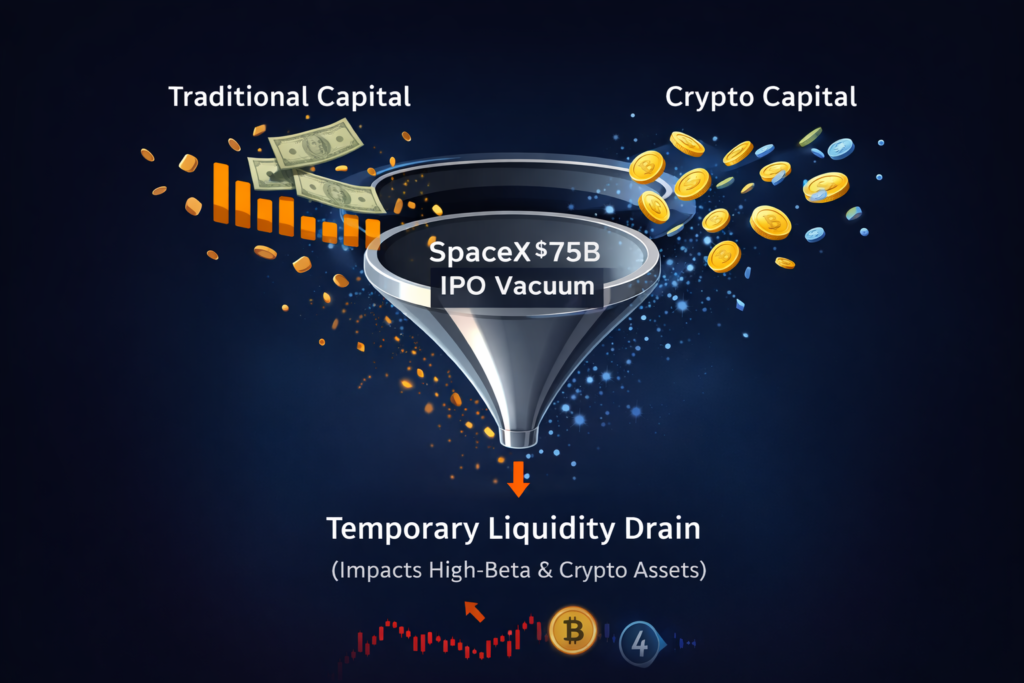
The Liquidity Vacuum: How Mega IPOs Drain Capital From Crypto
To understand why a massive equity listing can send tremors through the digital asset ecosystem, we must look at the concept of cross-asset market liquidity. Capital is not infinite. When a historic investment opportunity arises, funds must be drawn from existing allocations to capitalize on the new asset class.
The underlying thesis of how mega IPOs drain liquidity from Bitcoin is rooted in institutional and retail portfolio rebalancing.
1. Institutional Reallocations
Multi-strategy hedge funds and corporate treasuries treat Bitcoin and tech equities as part of the same “risk-on” bucket. With SpaceX opening up its order books for a massive $75 billion capital raise, fund managers are forced to liquidate a portion of their current winning positions to secure an allocation. Because Bitcoin has established deep institutional rails via spot ETFs, it has ironically become highly susceptible to being used as an immediate liquidity source to fund equity block purchases.
2. Retail Rotation
The SpaceX IPO has specifically reserved a historic volume of retail shares through consumer brokerages like Robinhood, Fidelity, and Charles Schwab. Retail investors who have spent the past few years parking capital in Bitcoin and high-beta altcoins are highly likely to rotate capital out of their crypto portfolios to buy into the SPCX hype on Day 1.
3. The Index Compression Effect
Once SpaceX goes public, its scale dictates an immediate, accelerated entry into major market indexes. Passive index funds and benchmark-tracking portfolios will be systematically required to purchase billions of dollars of SPCX shares. This forced buying structural dynamic creates a temporary capital drain on other speculative, high-growth assets, including cryptocurrency.
Balance Sheet Disclosures: Does SpaceX Holding 18,712 BTC Affect Bitcoin Price?
When SpaceX made its S-1 filing public, the most shocking revelation for the crypto community wasn’t the revenue margins of Starlink, but rather the company’s balance sheet. The statement disclosed that as of Q1 2026, SpaceX holds 18,712 BTC in its corporate reserves.
Purchased at an average price of $35,320 per coin since early 2021, SpaceX is sitting on more than 100% in unrealized profits, valuing their stash at approximately $1.45 billion. This places SpaceX as the seventh-largest corporate holder of Bitcoin globally, completely eclipsing sister company Tesla’s 11,509 BTC.
| Corporate Holder | Disclosed Bitcoin Holdings (2026) | Strategic Treasury Type |
| MicroStrategy | ~850,000 BTC | Digital Asset Treasury (DAT) |
| SpaceX (SPCX) | 18,712 BTC | Diversified Business Reserve |
| Tesla (TSLA) | 11,509 BTC | Diversified Business Reserve |
| Coinbase | ~9,000 BTC | Ecosystem / Infrastructure |
Does this massive cache present an active danger to the market? Let’s break down why SpaceX IPO may cause Bitcoin selling pressure, alongside the counter-arguments for structural stability.
The Bear Case: Why the IPO Could Trigger Selling Pressure
The primary anxiety among crypto market participants is the potential for a corporate liquidation event. Going public subjects a company to intense regulatory scrutiny, stringent quarterly earnings calls, and the whims of traditional institutional board members who may view volatile digital assets as an unnecessary balance sheet risk.
If activist investors or risk-averse board members demand that SpaceX clean up its balance sheet to minimize quarterly earnings volatility, a sudden market dump of 18,712 BTC could easily trigger cascading liquidations across crypto derivative exchanges. Furthermore, if SpaceX needs to rapidly deploy capital for capital-intensive projects—such as building out its 1-gigawatt xAI compute infrastructure or funding Starship production—their Bitcoin reserve represents a highly liquid vault waiting to be tapped.
The Bull Case: The Ultimate Institutional Validation
Conversely, looking at this through a more sophisticated lens reveals a highly bullish reality: SpaceX’s Bitcoin holdings represent just roughly 0.1% of its projected post-IPO market capitalization. Unlike MicroStrategy, which operates as a pure-play Digital Asset Treasury (DAT), SpaceX is a highly diversified, cash-flowing aerospace behemoth.
The fact that a company of this magnitude is going public on the Nasdaq while explicitly retaining a billion-dollar Bitcoin treasury sets a massive precedent. It effectively de-risks the asset class for other Fortune 500 companies. Instead of causing structural selling pressure, the IPO transitions SpaceX into the single largest diversified public corporation holding Bitcoin, allowing equity investors to gain indirect crypto exposure alongside cutting-edge aerospace and AI divisions.
The Macro Backdrop: Bitcoin Market Liquidity 2026
The timing of this listing is critical. The Bitcoin market liquidity 2026 environment is fundamentally sturdier than in past cycles. The broader crypto market structure entering the second half of 2026 is bolstered by peak stablecoin issuance volumes and an ongoing easing cycle from global central banks.
With the Federal Reserve systematically tracking interest rates down and quantitative tightening pausing, structural macroeconomic liquidity remains on a net-positive trajectory. While a $75 billion equity siphon is a massive event, the deep institutional liquidity provided by spot Bitcoin ETFs and crypto options markets provides a substantial cushion capable of absorbing short-term capital rotations.
Practical Analysis: Navigating the Listing Day Shift
From a professional trading standpoint, the interaction between the SpaceX IPO and Bitcoin will likely play out across three distinct phases:
- The Pre-IPO Congestion (1-2 Weeks Out): Expect sideways or slightly defensive price action from Bitcoin. Capital will begin quietly pooling in cash reserves in anticipation of the equity allocation pricing.
- The Listing Day Pivot (Day 1-3): As SPCX goes live on the Nasdaq, localized volatility in crypto may peak. Sudden retail or institutional capital rotations could create a temporary dip in Bitcoin’s price, offering a classic “buy the news” structural discount for long-term holders.
- The Post-Listing Equilibrium (1 Month+): Once passive index funds complete their structural buying of SPCX, capital will return to its standard equilibrium. Bitcoin’s correlation with high-growth tech will likely reassert itself, lifting both assets if the IPO proves to be a roaring success.
Conclusion: A Temporary Siphon or Long-Term Fuel?
Ultimately, the historic SpaceX IPO will undoubtedly affect Bitcoin, but not in the destructive manner that alarmists predict. While the sheer scale of a $75 billion capital raise will inevitably pull short-term liquidity away from risk assets, the broader structural trend is overwhelmingly positive.
SpaceX entering the public markets with 18,712 BTC firmly embedded in its S-1 filing is a watershed moment for institutional adoption. Rather than viewing the listing as a liquidity trap, savvy investors should recognize it as a structural bridge linking the heights of Web3 asset appreciation with the absolute frontier of Web2 industrial infrastructure.
This video breaks down the core financial mechanics behind the SpaceX listing, outlining how its record-shattering valuation and asset allocation structures work ahead of its official debut on the Nasdaq.

Henry Cross is a cryptocurrency writer, blockchain researcher, and market analyst with more than 10 years of experience covering digital assets, Bitcoin, altcoins, DeFi, and the evolving Web3 ecosystem. Throughout his career, he has built a reputation for delivering accurate market analysis, practical investment insights, and well-researched educational content that makes complex crypto topics accessible to a wide audience. Before joining Crypto Alpha Hub, Henry contributed to respected industry publications including Coinpedia and FXStreet, where he covered market trends, price analysis, blockchain developments, and emerging technologies. Today, as a contributor at Crypto Alpha Hub, he continues to provide timely research, in-depth market commentary, and expert crypto insights, helping readers stay informed and make confident decisions in the fast-moving digital asset industry.