
Imagine sending money to a friend in another country within seconds no bank delays, no high fees, no paperwork. Sounds convenient, right? This is exactly where what is cryptocurrency becomes an exciting question for beginners in 2026.
If you’ve heard about Bitcoin, Ethereum, or people earning online through crypto trading but felt confused, you’re not alone. Many people are stepping into the crypto world for the first time, hoping to understand how it works and how they can benefit from it.
In this guide, you’ll learn everything from the basics of cryptocurrency to how it works, its real-world uses, and how it compares to traditional money. By the end, you’ll have a clear and confident understanding—even if you’re starting from zero.
What is Cryptocurrency? (Simple Definition)
Cryptocurrency is a type of digital money that exists only online. It is not controlled by any government or central bank.
Instead of physical coins or paper bills, cryptocurrency uses blockchain technology (a secure digital record system) and cryptography (advanced coding for security) to operate.
In simple terms:
Cryptocurrency = Digital money + Secure technology + No central authority
Traditional Money vs Digital Currency vs Cryptocurrency
To understand cryptocurrency better, let’s compare it with what you already know.
Quick Comparison Table
| Feature | Cash Money (Dollar, Euro) | Digital Bank Money | Cryptocurrency |
|---|---|---|---|
| Form | Physical (cash, coins) | Digital (bank apps) | Fully digital |
| Control | Central banks | Banks & governments | Decentralized (no central authority) |
| Speed | Slow (especially international) | Moderate | Very fast |
| Fees | High for transfers | Medium | Low (sometimes minimal) |
| Security | Can be stolen physically | Bank-protected | Cryptography-secured |
| Transparency | Limited | Limited | Public blockchain record |
Key takeaway: Cryptocurrency gives you more control over your money without relying on banks.
Cryptocurrency Examples You Should Know
If you’re new, here are some popular cryptocurrencies:
- Bitcoin (BTC) – The first and most widely known cryptocurrency
- Ethereum (ETH) – Known for smart contracts
- Binance Coin (BNB) – Used on crypto exchanges
- Solana (SOL) – Fast and low-cost transactions
- Ripple (XRP) – Focused on global payments
Each serves a different purpose, but all operate on blockchain technology.
Types of Cryptocurrency
Cryptocurrencies come in several distinct categories, each designed with specific purposes and use cases in mind. Understanding these types helps clarify how different digital assets function within the broader blockchain ecosystem.
1. Coins (Native Cryptocurrencies)
Coins are digital currencies that operate on their own independent blockchains. They are primarily used as a medium of exchange, a store of value, or for transferring funds. Well-known examples include Bitcoin and Litecoin. These coins often serve as the foundational currency of their respective networks.
2. Tokens
Tokens are created on top of existing blockchain platforms, most commonly Ethereum. Instead of having their own blockchain, they rely on another network’s infrastructure. Tokens can represent a wide range of assets or functionalities, including access to services, voting rights, or even ownership in projects.
3. Stablecoins
Stablecoins are designed to minimize price volatility by being pegged to real-world assets such as fiat currencies (e.g., the US dollar), commodities, or other financial instruments. This stability makes them useful for everyday transactions, trading, and as a safe haven during market fluctuations.
4. Utility Tokens
Utility tokens are a specific type of token that provide access to a product or service within a blockchain ecosystem. For example, they may be used to pay transaction fees, unlock premium features, or interact with decentralized applications (dApps). Their value is often tied to the demand for the underlying platform.
How Cryptocurrency Works (Explained Simply)
Let’s break this down into three core parts.
1. Blockchain Technology (The Backbone)
Blockchain is like a digital ledger (record book) that stores all transactions.
Think of it like this:
- Every transaction is a “block”
- Blocks are linked together in a chain
- Once recorded, it cannot be changed
This makes crypto transparent and secure
2. What Decentralization Means
Traditional money is controlled by banks or governments.
Cryptocurrency is decentralized.
This means:
- No single authority controls it
- Power is distributed across many computers worldwide
Why it matters:
- More freedom
- Less risk of manipulation
- Global accessibility
3. The Role of Cryptography
Cryptography is the technology that keeps your crypto safe.
It uses complex math to:
- Protect transactions
- Verify ownership
- Prevent fraud
In simple terms: it’s like a super-advanced lock for your money.
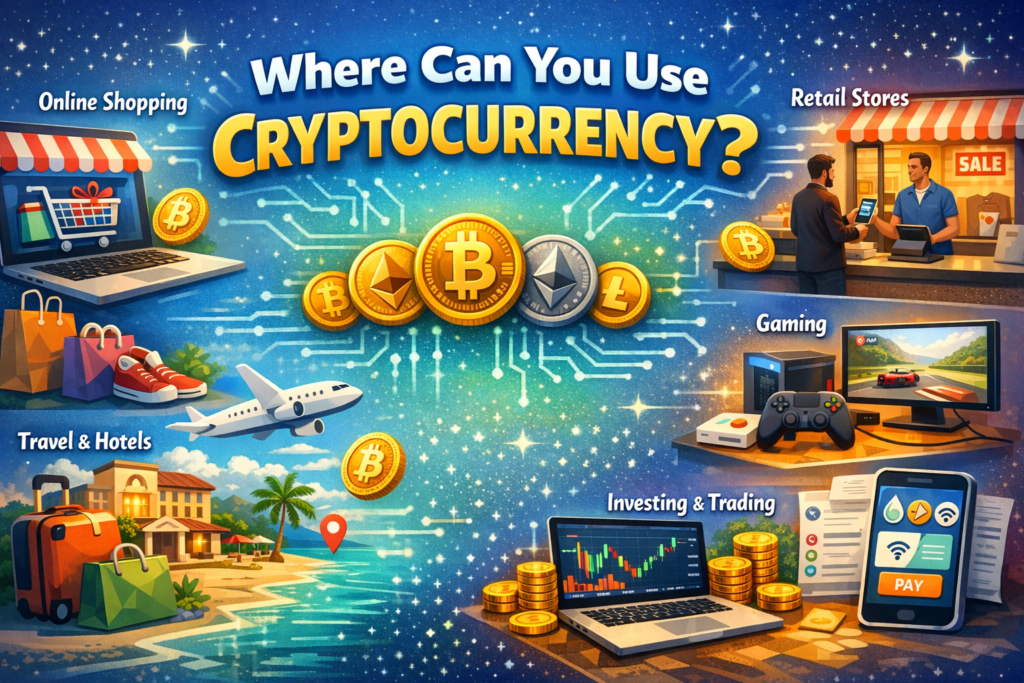
Where Can You Use Cryptocurrency?
Cryptocurrency is becoming more useful every year. In 2026, you can use it in many ways:
- Online shopping
- Freelance payments
- Investing and trading
- Sending money internationally
- Gaming and digital platforms
Many businesses now accept crypto as payment.
Real-World Uses of Cryptocurrency
Let’s explore how crypto is actually being used today.
1. Payments and Remittances
Sending money across borders is faster and cheaper with crypto.
Example:
Sending $500 internationally through a bank may take 3–5 days.
With crypto, it can take minutes.
2. Smart Contracts & DApps
Smart contracts are self-executing agreements (automatic contracts).
They run on decentralized apps (DApps), meaning:
- No middleman
- No delays
- Fully automated
3. Decentralized Finance (DeFi)
DeFi allows you to:
- Lend money
- Borrow funds
- Earn interest
Without needing a bank
4. NFTs and Digital Ownership
NFTs (Non-Fungible Tokens) represent ownership of digital items:
- Art
- Music
- Virtual assets
5. Cross-Border Transactions & Financial Inclusion
Crypto helps people without bank access:
- Especially in developing countries
- Easy access via smartphones
A Real-Life Story: From Beginner to Crypto User
Let’s make this real.
Ahmed, a freelancer from Dubai, used to wait days to receive payments from international clients. Bank fees were high, and delays were frustrating.
In 2024, he started using cryptocurrency.
Now:
- Payments arrive within minutes
- Fees are minimal
- He even invests a portion of his earnings
Ahmed didn’t become a trading expert overnight. He simply learned step-by-step—just like you can.
Is Cryptocurrency Safe?
This is one of the most common questions.
Safe When:
- You use trusted platforms
- You protect your wallet keys
- You avoid scams
Risky When:
- You invest blindly
- You follow hype without research
- You ignore security practices
- Crypto is powerful—but requires responsibility.

Advantages and Disadvantages of Cryptocurrency
Advantages
- Fast transactions
- Low fees
- Global access
- No bank required
Disadvantages
- Price volatility
- Learning curve for beginners
- Risk of scams
The Future of Cryptocurrency in 2026
Cryptocurrency is no longer just a trend—it’s becoming part of everyday finance.
- More businesses accept crypto
- Governments are regulating it
- Blockchain is used beyond finance
The future looks promising, but still evolving.
Conclusion
So, what is cryptocurrency? It’s more than just digital money—it’s a new way of thinking about finance.
From fast global payments to decentralized finance and digital ownership, cryptocurrency is changing how the world interacts with money.
If you’re starting from zero, don’t worry. Everyone begins somewhere. The key is to learn step by step, stay cautious, and keep improving your understanding.

Henry Cross is a cryptocurrency writer, blockchain researcher, and market analyst with more than 10 years of experience covering digital assets, Bitcoin, altcoins, DeFi, and the evolving Web3 ecosystem. Throughout his career, he has built a reputation for delivering accurate market analysis, practical investment insights, and well-researched educational content that makes complex crypto topics accessible to a wide audience. Before joining Crypto Alpha Hub, Henry contributed to respected industry publications including Coinpedia and FXStreet, where he covered market trends, price analysis, blockchain developments, and emerging technologies. Today, as a contributor at Crypto Alpha Hub, he continues to provide timely research, in-depth market commentary, and expert crypto insights, helping readers stay informed and make confident decisions in the fast-moving digital asset industry.