
If you are new to the world of cryptocurrency, one of the first questions you will likely ask is a simple but important one: what is blockchain? At its core, blockchain is a digital system for recording information in a way that is secure, transparent, and extraordinarily difficult to alter. Rather than being stored in a single location like a traditional database, this information is distributed across thousands of computers around the world simultaneously.
Understanding blockchain matters because it is the very foundation on which cryptocurrencies like Bitcoin and Ethereum are built. Without this foundation, crypto can feel like an abstract, risky concept. With it, the logic behind digital money starts to fall into place naturally. The technology rests on three powerful ideas: the ability to establish trust without relying on a middleman, transparency that anyone can verify independently, and a resistance to tampering that protects recorded data from being quietly changed.
A helpful way to picture it is to imagine a shared spreadsheet that thousands of people can see and verify, but that no single person can secretly edit. That is the essence of what makes blockchain so significant.
Breaking It Down: Blocks, Chains, and Hashes
To truly understand blockchain, it helps to start with its most basic components.
A block is simply a bundle of data. In the context of cryptocurrency, it typically contains a list of recent transactions alongside some technical metadata. A chain is exactly what it sounds like — blocks linked together one after another in a continuous, time-ordered sequence. Every new block connects to the one before it, creating a permanent and unbroken record.
What makes this structure so secure is something called a hash — a unique digital fingerprint assigned to each block. Even the tiniest change to the data inside a block produces a completely different hash. Since every block also contains the hash of the block before it, the entire chain is interconnected. If someone attempts to tamper with one block, the fingerprints no longer match, and the manipulation becomes immediately visible to everyone in the network.
How a Transaction Actually Works
Seeing blockchain in action through a concrete example makes it much easier to grasp. Here is what happens when you send Bitcoin to a friend.
First, you initiate the transaction from your wallet, and it is broadcast to a global network of computers. These computers — known as nodes — work together to verify that the transaction is legitimate, confirming, for example, that you actually hold sufficient funds. Once validated, your transaction is grouped together with other recent transactions into a new block. The network then reaches a collective agreement, and the block is permanently added to the chain. No bank approved it. No central authority signed off. The network itself handled everything.
This process illustrates one of blockchain’s most defining qualities: it allows complete strangers to transact with one another in a trustworthy way, without needing a trusted institution to sit in the middle.
The Key Properties That Set Blockchain Apart
Blockchain is fundamentally different from a conventional database, and understanding why requires looking at a few key properties.
It is decentralized, meaning no single company, government, or individual controls it. Every participating node holds a complete copy of the ledger, which dramatically reduces the risk of manipulation or single points of failure. It is transparent, meaning that transactions on public blockchains can be verified by anyone. It is immutable, meaning that once data has been recorded, altering it is not just difficult — it is practically impossible at scale. And it is peer-to-peer, allowing people to interact directly without intermediaries like banks or payment processors standing between them.
These qualities, taken together, are why many observers consider blockchain to be a genuinely transformative technology rather than simply a new kind of database.
Blockchain vs. Cryptocurrency: Clearing Up the Confusion
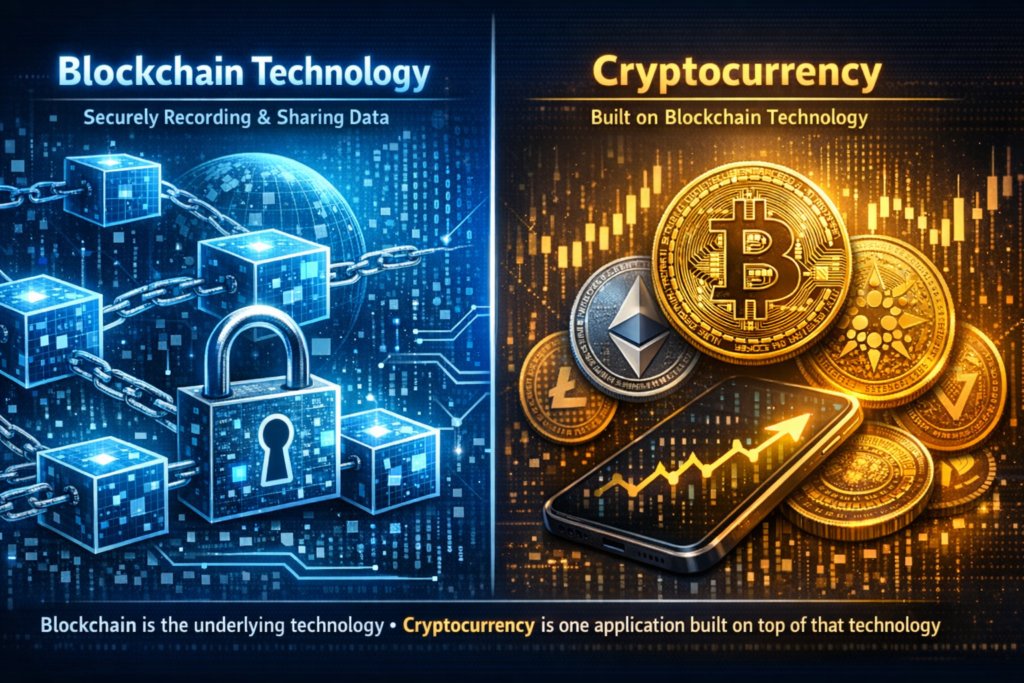
One of the most common misconceptions among newcomers is treating blockchain and cryptocurrency as the same thing. They are not.
Blockchain is the underlying technology — a method for securely recording and sharing data. Cryptocurrency is one application built on top of that technology. Bitcoin, for instance, uses blockchain to record and verify all of its transactions, ensuring that digital money cannot be copied or spent twice. But blockchain itself has no inherent connection to money. It is a tool for establishing trust and recording information, and its potential uses extend far beyond finance.
Not All Blockchains Are the Same
Blockchains come in several varieties, each suited to different purposes. Public blockchains, like Bitcoin and Ethereum, are open to anyone. Anyone can join, verify transactions, and contribute to the network. Private blockchains are controlled by a single organization and are typically used for internal business processes where access needs to be restricted. Consortium blockchains sit somewhere in the middle — managed jointly by a group of organizations, they are common in industries that require shared oversight without full public access.
Real-World Applications Beyond Crypto
Blockchain is already being put to use across a surprisingly wide range of industries. In global payments, it enables fast, borderless transfers without the need for traditional banks. In supply chains, companies use it to trace products from origin to destination — knowing, for example, exactly which farm a piece of fruit came from and every step it took to reach the store shelf. In healthcare, it allows medical records to be shared securely between providers while protecting patient privacy. In government, it offers a more tamper-resistant way to maintain land registries, voting systems, and public records.
These applications make it clear that understanding blockchain is relevant far beyond the question of whether to invest in cryptocurrency.
The Honest Limitations
For all its strengths, blockchain is not a perfect technology. Some networks can become slow and expensive to use during periods of high demand. Certain blockchains consume significant amounts of energy. Transactions are irreversible — if you send funds to the wrong address, there is no undo button and no customer support line to call. And while the blockchain itself is highly secure, the broader crypto ecosystem still attracts bad actors, scams, and poorly designed projects. Being aware of these limitations is just as important as appreciating the technology’s strengths.
A Simple Story to Tie It Together
Imagine Alice wants to send money to Bob. She creates the transaction, and the network verifies that she has enough funds. The transaction is confirmed and added to a block, which is then linked to all the blocks that came before it. The record is now permanent.
Now suppose someone tries to go back and alter Alice’s transaction after the fact. To do so, they would need to change not just that one block, but every single block that followed it, across thousands of computers simultaneously. The sheer impracticality of this is what makes blockchain so secure. Think of it as a public receipt book shared among thousands of witnesses — once an entry is confirmed, it simply cannot be quietly erased.
A Quick Reference Glossary
Block — A group of verified transactions bundled together.
Chain — A sequence of connected blocks forming a complete history.
Node — A computer participating in the network.
Ledger — The full, shared record of all transactions.
Hash — A unique digital fingerprint for each block.
Consensus — The method by which the network agrees on what to add.
Wallet — A tool for storing and managing cryptocurrency.
Mining — The process of validating transactions and adding them to the chain.
Staking — Locking up cryptocurrency to help secure a network in exchange for rewards.
Smart contract — A self-executing digital agreement that runs automatically on a blockchain.
Final Thoughts
Blockchain is, at its simplest, a secure and decentralized system for recording and verifying data in a way that is transparent and nearly impossible to alter. It powers cryptocurrencies, yes — but its implications stretch far beyond digital money, touching everything from global logistics to personal identity to public governance.
If you are beginning your journey into crypto, building a solid understanding of blockchain is the single best first step you can take. It gives you the conceptual foundation needed to make sense of everything that follows — wallets, tokens, DeFi, NFTs, and beyond.

Henry Cross is a cryptocurrency writer, blockchain researcher, and market analyst with more than 10 years of experience covering digital assets, Bitcoin, altcoins, DeFi, and the evolving Web3 ecosystem. Throughout his career, he has built a reputation for delivering accurate market analysis, practical investment insights, and well-researched educational content that makes complex crypto topics accessible to a wide audience. Before joining Crypto Alpha Hub, Henry contributed to respected industry publications including Coinpedia and FXStreet, where he covered market trends, price analysis, blockchain developments, and emerging technologies. Today, as a contributor at Crypto Alpha Hub, he continues to provide timely research, in-depth market commentary, and expert crypto insights, helping readers stay informed and make confident decisions in the fast-moving digital asset industry.