Decentralized Finance has quietly become one of the most consequential shifts in the history of money and yet for most beginners, it still feels like a mystery wrapped in jargon. The concept is actually simpler than it sounds. At its core, DeFi is about rebuilding the financial services you already use lending, saving, trading, investing but without banks, brokers, or any central authority in the middle. This guide walks through everything you need to know: how DeFi works, why it matters, what you can actually do with it, and what to watch out for before you dive in.
What Is Decentralized Finance?
DeFi refers to a growing ecosystem of financial applications built on blockchain networks that operate without traditional intermediaries. Instead of relying on a bank to approve a loan or a broker to execute a trade, these systems use self-executing code known as smart contracts to carry out transactions automatically according to pre-set rules.
What makes DeFi significant in the crypto world is that it dramatically expands what digital assets can do. Rather than simply holding or sending cryptocurrency, users can lend, borrow, earn yield, trade, and invest all directly from their own wallets, without ever opening a bank account or submitting an application. In that sense, DeFi transforms cryptocurrency from a speculative asset class into a fully functioning financial ecosystem.
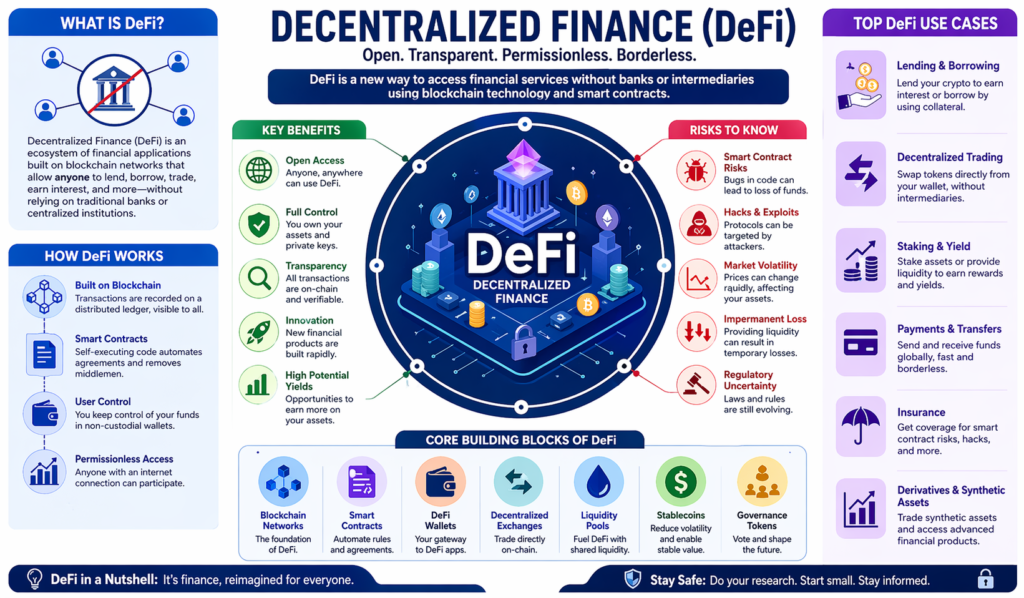
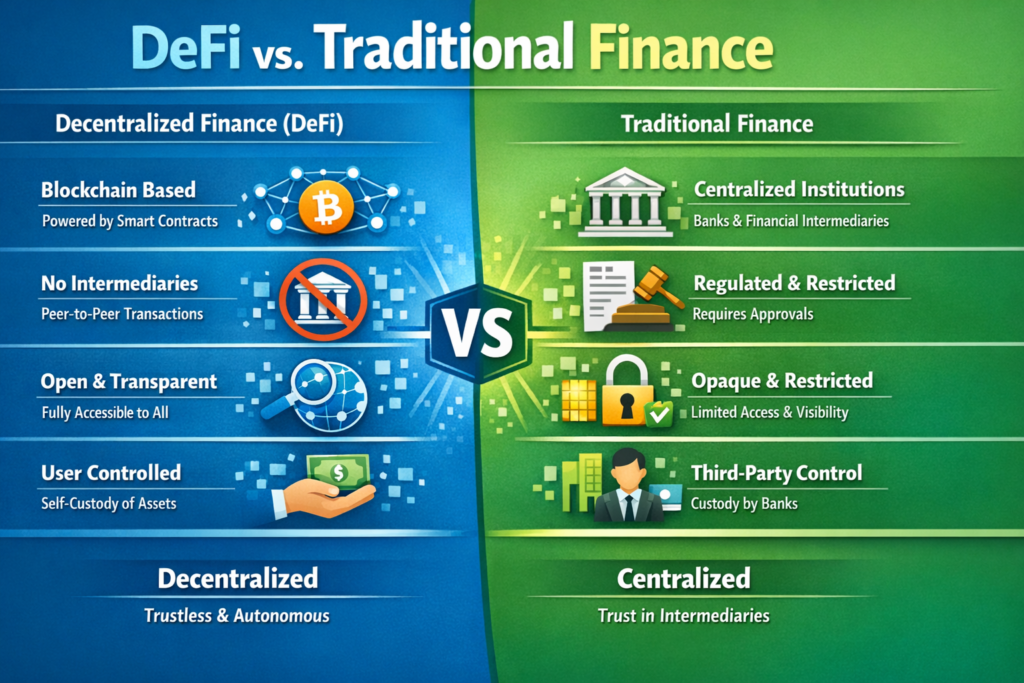
The contrast with traditional finance is stark. Conventional banking depends on centralized control: banks hold your money, approve or deny your transactions, and charge fees for the privilege. DeFi removes that control layer entirely. You interact directly with protocols, you maintain custody of your own funds at all times, and you access services without needing anyone’s permission.
How DeFi Works
Blockchain as the Foundation
Every DeFi application is built on top of a blockchain a distributed, tamper-resistant ledger that records transactions transparently and securely. Because the ledger is public and maintained by a decentralized network of computers rather than a single company, no single party can alter records or shut the system down. This is what makes DeFi possible in the first place.
Smart Contracts: The Engine Behind DeFi
If blockchain is the foundation, smart contracts are the engine. These are programs that live on the blockchain and execute automatically when certain conditions are met no human approval required. A lending protocol, for instance, can issue a loan the moment a user posts sufficient collateral, without a loan officer, a credit check, or a waiting period. The rules are embedded in the code, and the code doesn’t play favorites or take days off.
Non-Custodial Wallets and User Control
To use DeFi, you need a non-custodial wallet one where you hold your own private keys, not a third party. This is a fundamental shift from traditional finance and even from centralized crypto exchanges. When you control your private keys, you control your assets. Nobody can freeze your account or block a transaction. The flip side, of course, is that you bear full responsibility for keeping those keys safe.
Permissionless and Transparent by Design
DeFi is open to anyone with an internet connection and a compatible wallet. There are no account approvals, no credit scores, no identity checks. Simultaneously, every transaction is recorded on a public blockchain, meaning anyone can verify what happened, when, and for how much. This combination of openness and transparency is genuinely novel in the history of finance.
DeFi vs. Traditional Finance
Banks vs. DeFi Protocols
Banks act as custodians and intermediaries they hold your money, process your payments, and stand between you and financial services. DeFi replaces that intermediary layer with code. While banks offer stability, consumer protections, and regulatory oversight, DeFi offers greater accessibility and puts users in direct control. Neither is categorically better; they serve different needs and carry different trade-offs.
Centralized Exchanges vs. Decentralized Exchanges
A centralized exchange like Coinbase or Binance holds your funds on your behalf and manages trades internally. A decentralized exchange lets you trade tokens directly from your own wallet without ever surrendering custody. The experience is different decentralized exchanges can be less intuitive but the principle of keeping control of your assets is worth understanding.
DeFi vs. CeFi
Centralized Finance (CeFi) is the middle ground: companies that offer crypto services but still operate with the trust model of traditional institutions. You’re using blockchain assets, but you’re trusting a company to manage them safely. DeFi removes that company from the equation. Whether that’s a feature or a risk depends entirely on your comfort level and technical confidence.
The Core Building Blocks of DeFi
To understand DeFi, it helps to know the components that make it run. Blockchain networks provide the infrastructure — different chains offer varying speeds, costs, and capabilities, with Ethereum being the most widely used for DeFi applications. Smart contracts automate the financial logic. Wallets serve as the user’s interface to the entire ecosystem.
Beyond that infrastructure, several specific components appear across virtually every DeFi application. Decentralized exchanges enable peer-to-peer token swaps. Liquidity pools are collections of user-supplied funds that make those swaps possible. Stablecoins — cryptocurrencies pegged to assets like the US dollar reduce the volatility that would otherwise make lending and borrowing impractical. And governance tokens give users a voice in how protocols evolve, with holders voting on key decisions like fee structures and protocol upgrades.
Main DeFi Use Cases
Lending and Borrowing
One of the most popular DeFi applications is lending and borrowing without a bank. Users can deposit their crypto into a lending protocol and earn interest, while borrowers can take out loans by posting collateral typically more crypto than they’re borrowing. This overcollateralized model removes the need for credit checks, since the collateral itself is the guarantee.
Decentralized Trading
Token swaps on decentralized exchanges happen instantly through automated pricing algorithms called automated market makers. There are no order books, no waiting for a counterparty, and no intermediary holding your funds. You connect your wallet, confirm the trade, and the tokens move.
Yield Opportunities
DeFi offers multiple ways to put idle assets to work. Users can provide liquidity to trading pools and earn a share of trading fees. They can stake tokens to support a network and receive staking rewards. Or they can participate in more complex yield farming strategies that move funds across protocols to chase the best returns. The yields available in DeFi can significantly exceed those of traditional savings accounts though they come with commensurately higher risks.
Payments, Insurance, and Beyond
DeFi also enables fast, borderless payments without the fees and delays of traditional banking infrastructure. More specialized protocols offer decentralized insurance products covering risks like smart contract failures as well as derivatives and synthetic assets that let users gain exposure to real-world or crypto asset prices without directly holding those assets.
How People Use DeFi in Real Life
The theoretical use cases become concrete when you look at how real users actually engage with DeFi. Someone holding ETH they don’t want to sell can deposit it into a lending protocol and earn yield on it passively. A trader can swap between tokens directly from their hardware wallet, avoiding the account requirements and withdrawal limits of centralized platforms. A person in a country with limited banking access can use DeFi for savings and payments that would otherwise be unavailable to them.
More active participants contribute funds to liquidity pools and earn trading fees, vote on governance proposals that shape the protocols they use, or borrow against their crypto holdings to access cash without triggering a taxable sale. DeFi is modular by nature users can engage with as little or as much of it as their knowledge and risk tolerance allow.
Benefits of Decentralized Finance
The most compelling case for DeFi comes down to access and control. Anyone with an internet connection and a wallet can participate, regardless of where they live, how much money they have, or whether they have a credit history. There are no gatekeepers.
Beyond access, DeFi offers genuine financial transparency transactions are publicly visible on-chain, making it harder for hidden risks to accumulate undetected. The pace of innovation is also remarkable; new financial primitives appear regularly in ways that traditional financial institutions simply cannot match. And for users comfortable with the risks, DeFi can deliver yields on crypto holdings that conventional savings accounts haven’t offered in years.
Risks of DeFi
Honest discussions of DeFi have to spend equal time on the risks, because they are real and sometimes severe.
Smart contract vulnerabilities are perhaps the most fundamental: the same code that removes human error from transactions can itself contain bugs, and those bugs can be exploited to drain protocol funds. Hacks and exploits have cost DeFi users billions of dollars, and no protocol is entirely immune. Market volatility can turn profitable strategies into losing ones quickly, and borrowers face liquidation risk if the value of their collateral drops below the required threshold.
Liquidity providers face a specific risk called impermanent loss a reduction in value relative to simply holding the assets, caused by price divergence in the pool. Regulatory uncertainty adds another layer of risk, as governments are still determining how to treat DeFi activities and what compliance requirements might emerge. And unlike a bank, DeFi offers no recourse for mistakes: transactions are irreversible, and sending funds to the wrong address or network typically means losing them permanently.
Scams and fraudulent protocols are also widespread. The permissionless nature of DeFi means anyone can launch a project, and not everyone has good intentions.
Is DeFi Safe for Beginners?
Safety in DeFi is relative and earned through knowledge, not guaranteed by any institution. There’s no FDIC equivalent, no customer support line, and no refund policy. What you can do is significantly reduce your risk through education and caution.
Common beginner mistakes include chasing extremely high APY without understanding the underlying risks, failing to verify whether a protocol has been audited, and making transactions without fully understanding the fee structure. Starting with well-established, audited protocols rather than chasing the newest launch dramatically reduces exposure to the most common failure modes. Using a hardware wallet adds another layer of security. And testing with small amounts before committing meaningful capital is simply good practice.
How to Get Started with DeFi
Getting started in DeFi involves a handful of straightforward steps. First, choose and set up a non-custodial wallet that supports DeFi applications — MetaMask is the most widely used option for Ethereum-based protocols. Fund it by purchasing crypto on a centralized exchange and transferring it to your wallet address. Then connect your wallet to a DeFi platform by visiting the application’s website and authorizing the connection.
From there, starting with simple actions like token swaps or depositing into a lending protocol gives you hands-on experience without excessive complexity. Before confirming any transaction, always check the details — including the gas fee — and make sure you’re on the legitimate version of the platform and not a phishing copy. Start small, learn the mechanics, and scale up as your confidence grows.
Popular Types of DeFi Platforms
The DeFi ecosystem is home to several distinct categories of platforms, each serving a different purpose. Decentralized exchanges like Uniswap and Curve enable peer-to-peer token trading. Lending protocols like Aave and Compound allow users to earn interest or borrow against collateral. Yield farming platforms and aggregators like Yearn help users find and deploy capital into the most efficient opportunities across multiple protocols. Liquid staking platforms let users stake ETH or other assets while receiving a liquid token they can continue using across DeFi.
Key Metrics for Evaluating a DeFi Protocol
When assessing whether a DeFi project is worth using, a few metrics matter more than others. Total Value Locked (TVL) indicates how much capital users have entrusted to the protocol — generally, higher TVL suggests more user confidence. Trading volume and liquidity depth tell you how active and efficient the platform is. Audit status is critical: protocols that have been reviewed by reputable security firms carry meaningfully less smart contract risk than those that haven’t. Token utility and the health of the governance community round out the picture, as protocols with engaged, active communities tend to be better maintained over time.
DeFi Trends and the Road Ahead
DeFi adoption continues to grow as both retail and institutional participants recognize its potential. Layer 2 scaling solutions are making transactions on Ethereum far faster and cheaper, removing one of the main friction points for new users. Cross-chain interoperability — the ability to move assets seamlessly between blockchains — is expanding what’s possible and connecting previously siloed ecosystems.
One of the most significant trends is the tokenization of real-world assets: putting things like real estate, bonds, and commodities on-chain so they can be traded, fractionalized, and used as collateral in DeFi protocols. Meanwhile, regulatory clarity is slowly emerging in major markets, which, while it introduces compliance requirements, may ultimately bring greater institutional confidence and broader adoption.
Common Beginner Mistakes to Avoid
A few patterns appear repeatedly among users who lose money in DeFi. Chasing extremely high advertised APY is perhaps the most common — if a yield looks unrealistically high, it usually reflects hidden risk, token inflation, or outright fraud. Using unaudited protocols removes one of the most important safety checks available. Ignoring gas fees can erode returns significantly, especially on Ethereum mainnet. Falling for phishing scams — cloned websites designed to steal wallet credentials — is avoidable by always verifying URLs directly. And sending funds to the wrong blockchain network, which is easier to do than you might expect, can result in permanent loss.
DeFi Glossary
APY — Annual Percentage Yield; the annualized return on a deposit or investment, including compounding.
Liquidity Pool — A pool of tokens locked in a smart contract that facilitates trading or lending on a decentralized platform.
Impermanent Loss — The temporary reduction in value that liquidity providers experience when the prices of their deposited assets diverge.
Smart Contract — Self-executing code stored on a blockchain that automatically carries out transactions when conditions are met.
Gas Fee — The fee paid to the network to process a transaction on a blockchain like Ethereum.
Non-Custodial Wallet — A wallet in which the user holds their own private keys and maintains direct control of their assets.
TVL (Total Value Locked) — The total amount of assets deposited into a DeFi protocol, often used as a measure of its size and adoption.
Frequently Asked Questions
What does DeFi stand for? DeFi stands for Decentralized Finance — a collection of financial services and applications built on blockchain networks that operate without traditional intermediaries.
How does DeFi work? DeFi uses smart contracts to automate financial transactions. When predefined conditions are met, the contract executes automatically — no banks, brokers, or approvals required.
Is DeFi the same as crypto? Not exactly. Cryptocurrency is the asset; DeFi is the ecosystem of financial applications that use those assets. Think of crypto as the money and DeFi as everything you can do with it.
Can you make money with DeFi? Yes — through lending, staking, liquidity provision, and yield farming. But returns are never guaranteed and always accompanied by risk. Higher yields typically mean higher risk.
What are the biggest risks in DeFi? Smart contract bugs, hacks and exploits, market volatility, liquidation risk, impermanent loss, regulatory uncertainty, and user error are the primary risks to understand before participating.
Do I need a wallet to use DeFi? Yes. A non-custodial wallet is essential — it’s your identity, your gateway, and your vault within the DeFi ecosystem.
Is DeFi legal? It depends on the jurisdiction. DeFi itself is generally not banned in most countries, but specific activities may be subject to local financial regulations that are still evolving. Always check the rules in your region.
Conclusion
Decentralized Finance is one of the more genuine paradigm shifts in how financial systems can be structured. By replacing institutional intermediaries with transparent code and giving users direct control over their assets, DeFi opens up financial participation to people and places that traditional banking has long overlooked. That doesn’t make it risk-free or simple — it’s neither — but for those willing to invest the time to understand it, DeFi represents a meaningfully different way to engage with money. The technology is still maturing, the regulations are still forming, and the risks are real. But so is the potential.

Henry Cross is a cryptocurrency writer, blockchain researcher, and market analyst with more than 10 years of experience covering digital assets, Bitcoin, altcoins, DeFi, and the evolving Web3 ecosystem. Throughout his career, he has built a reputation for delivering accurate market analysis, practical investment insights, and well-researched educational content that makes complex crypto topics accessible to a wide audience. Before joining Crypto Alpha Hub, Henry contributed to respected industry publications including Coinpedia and FXStreet, where he covered market trends, price analysis, blockchain developments, and emerging technologies. Today, as a contributor at Crypto Alpha Hub, he continues to provide timely research, in-depth market commentary, and expert crypto insights, helping readers stay informed and make confident decisions in the fast-moving digital asset industry.